

MES (Manufacturing Execution System): what is it?
In the global trend towards digitalization, MES solutions are a key element for manufacturers aiming to harness information technology to improve productivity, quality, and responsiveness.
The MES market is booming, and industrial players in a wide range of sectors are taking an interest in it to boost their competitiveness.
What is a MES?
A MES (Manufacturing Execution System) is an information system used in production workshops to bridge the gap between the ERP (Enterprise Resource Planning) and production operators and automated machines. It operationally supports the execution of the production process and assists all shop floor management processes by providing real-time relevant information to supervisors about the production tool’s status and progress against the production plan.
This enables better decision-making to meet production goals despite disruptions or changes from suppliers or customers.
Additionally, it collects valuable operational data for reporting (especially on production costs) and continuous improvement initiatives.
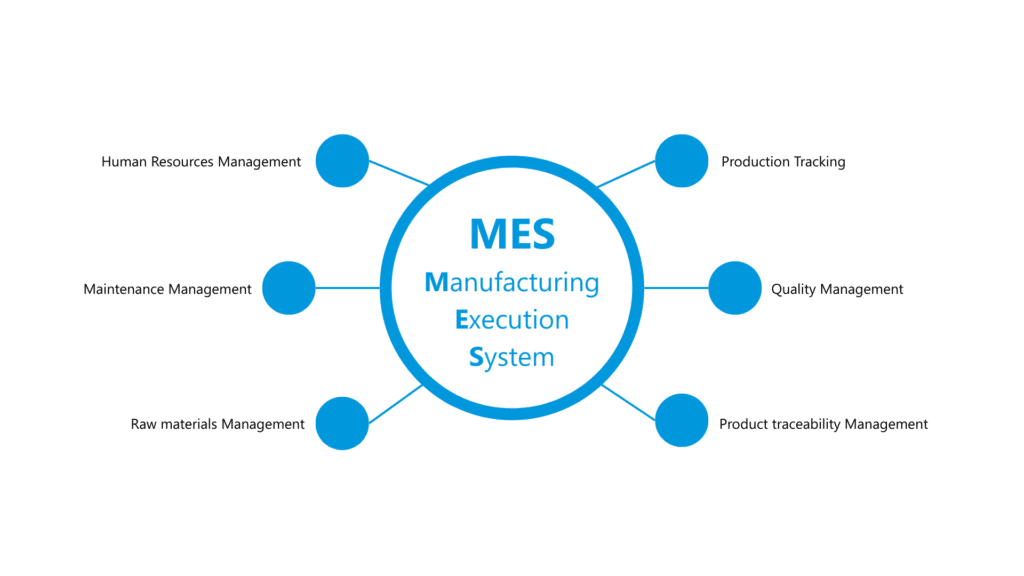
A MES typically includes 6 main functions:
Who should consider implementing a MES?
As previously mentioned, a MES is a valuable asset for improving productivity by leveraging computing power for production optimization.
However, certain prerequisites and challenges must be addressed by organizations aiming to implement it.
Prerequisites for MES deployment:
- A fully operational ERP system with accurate and reliable production planning and tracking functionality. It requires well-defined and documented manufacturing processes in the ERP (BOMs and routings).
- Proper ERP configuration to utilize time and quantity data validated in production routings.
- Availability of method data in a document management system (DMS), PDM, or PLM to support operators.
Challenges of MES deployment:
- Financial: MES requires significant customization, leading to high internal and external costs for specification, development, and testing. In addition, it must be deployed across most workstations, requiring substantial investment in IT hardware and network infrastructure.
- User Adoption: Operators, often unfamiliar with IT systems, must adapt to new data entry tasks.
- Customization: Each workshop has unique needs, requiring tailored solutions.
- System Integration: Seamless integration with ERP and other systems is critical for MES functionality.
To conclude, any organization planning to implement an MES must set aside sufficient funds and ensure that its business and IT teams are available and competent in the various aspects of the project.
Why deploy a MES?
As a production execution support system, the primary contribution of an MES is to the operational performance of the concerned workshop(s).
The MES enables production site management to be rapidly informed of the workshop status, so that any problem that arises can be resolved as quickly as possible. Changes in customer demand (quantities, dates, etc.) and supply delays are also better managed.
As a result, resources are used more efficiently, and the system is more responsive.
Secondly, this system brings useful information right to the operators‘ workstations. They have access not only to production data (everything that goes to make up a production order: part number, quantity to be produced, requested delivery date, components to be assembled or materials to be used), but also to the methods documents required for their operations (operating procedures, production cycles, production equipment manuals, etc.). Consequently, if production priorities change during the day, as mentioned in the first point, operators have direct access to up-to-date data. This greatly facilitates priority management.
Finally, the MES system is a powerful tool for collecting production data:
- Operators enter the quantities of parts produced.
- Manual and automated production times can be collected, giving a precise overview of the time spent producing each part.
- Production incidents occurring on the various equipment are captured and timed. This facilitates collaboration with the maintenance team, by example.
- Operators can also simply enter quality-related data (non-conformities, derogation requests, production traceability information).
This list is not exhaustive. For example, it can also be used to manage data relating to the management of precious materials.
The MES generates—or rather captures—a large volume of data that can be used for reporting, as well as for analyses aimed at targeting the company’s continuous improvement initiatives.
How to deploy a MES?
The deployment of an MES system generally follows standard project management methodologies for new IT tools.
Nevertheless, as outlined in the challenges posed by the MES deployment, certain aspects must be carefully examined, and compromises defined to arrive at the most effective solution for the company.
IT Architecture
The first point is the integration of the MES into the company’s overall IT landscape.
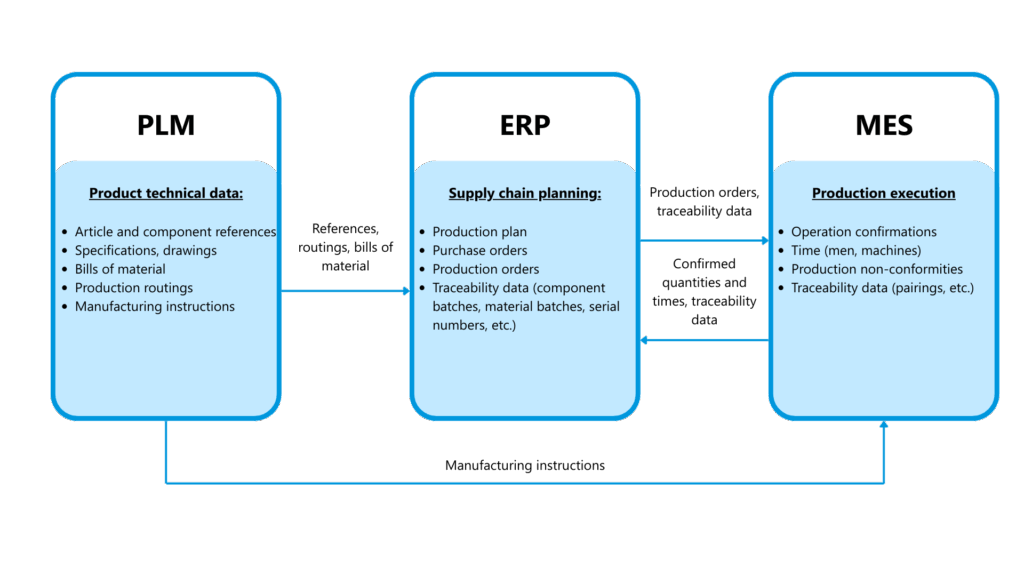
Interfacing the MES with the ERP is crucial for ensuring reliable operation that delivers value to the company.
This integration is essential, as the ERP provides the MES with the production plan and manufacturing order data.
It represents a strong coupling that must be thoroughly and accurately defined, including real-time handling of any errors that may occur between the two systems.
Furthermore, the data generated by the MES is partially fed back into the ERP—at the very least to confirm the parts produced and validate deliveries. The quantities produced are thus systematically reported back to the ERP, and the time spent producing them can help refine production cost calculations.
Integration with the PLM system is also possible, provided the company has reached a sufficient level of maturity. The PLM must supply the MES with product and production-related data. While some of this information may come from the ERP (such as routings and bills of materials), the PLM can usefully complement it with product visuals and more detailed production instructions, for example.
Finally, in some workshops, machine tools are already in place and integrating them with the MES is often beneficial to leverage the data they generate automatically. However, this integration requires significant effort and the involvement of new stakeholders—potentially as many as there are different equipment suppliers.
Other integrations are also possible, such as with quality management systems or human resources systems.
Integration with these systems and particularly with ERP systems, which require strong coupling, must be studied and defined in agreement with the enterprise architects and the managers of these third-party systems.
Deployment strategy
It is common for the scope of a MES deployment to cover more than one workshop. The usage and needs of each workshop may vary significantly depending on their technologies and production methods. Groupings can be made, but it is important to adapt the system to each specific case.
For example, assembly workshops have very different considerations compared to machining workshops.
If the company has very different types of workshops, it is recommended to conduct a global functional needs assessment before defining the overall solution. Then, the tool can be adapted to the different functional groups in separate projects, starting from a representative Core Model and then rolling it out to the other groups in a second phase.
Usability, Ergonomics, and Change Management
The final point concerns the impact of change on operational teams.
Particular attention must be paid to the system’s ergonomics. Operators will spend a certain amount of time entering data into the MES (since deploying the MES involves creating new data that was not previously generated). This time must be optimized through user-friendly software and practical physical terminals deployed in the workshops.
Both aspects must be carefully analyzed, and alternatives tested and compared to achieve the best outcome. To this end, end-users should be involved as early as possible in the project—starting from the solution definition phase, and especially during the validation and evaluation of alternatives. Some data may be so time-consuming to enter that innovative solutions will need to be imagined—or, failing that, the data entry may need to be abandoned.
As a result, users will face many changes. IT tools are not always part of operators’ usual work environment. And even if they are, this will be a new system. Therefore, a communication plan must be established from the beginning of the project, and user populations should be involved early on, starting with the solution definition.
Finally, a comprehensive training plan must be developed to ensure that users can work with the new system from the moment it is deployed.


